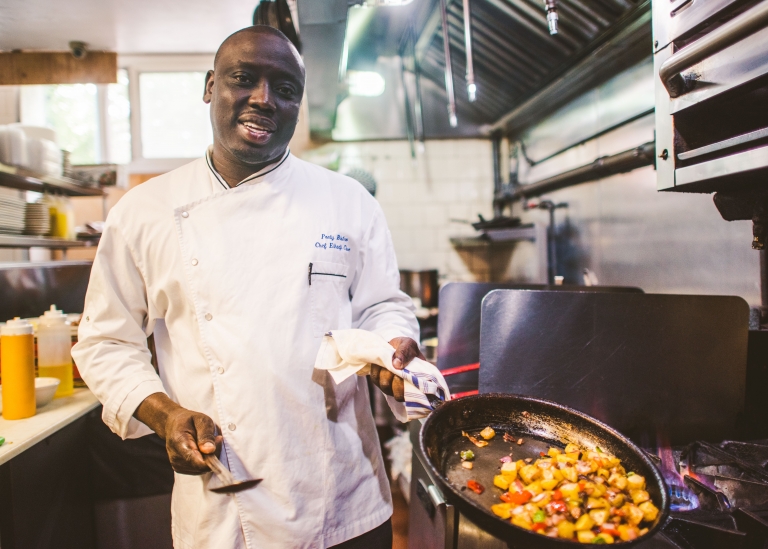
The Taste of Power: How Chef Elhadji Cisse is Anchoring Harlem’s New Renaissance
The Taste of Power: How Chef Elhadji Cisse is Anchoring Harlem’s New Renaissance
By: Brett Collier, Harlem Thrive
Published: February 2026
In the heart of Upper Manhattan, where the echoes of jazz legends meet the modern bustle of 7th Avenue, a new kind of history is being written. It isn't just being written in books; it is being plated, sautéed, and served. As we celebrate Black History Month this February, Harlem Thrive is proud to spotlight a man who has become a foundational pillar of the community: Chef Elhadji Cisse.
Our conversation, titled "The Taste of Power: How Chef Elhadji Cisse is Anchoring Harlem’s New Renaissance," dives deep into what it means to build a legacy that survives economic shifts, gentrification, and the passage of time.

1. The Collision of Anniversaries: 2026 and the Weight of History
The year 2026 is not just another date on the calendar. It represents a rare "dual milestone" in the American story. While the United States celebrates its Semiquincentennial (250th anniversary), the African American community commemorates the Centennial (100th anniversary) of Black History Month—which began as Negro History Week in 1926.
For Chef Cisse, being a business owner in Harlem during this era feels like a sacred stewardship. He doesn't just see his restaurants—Ponty Bistro, Renaissance Harlem, Harlem Cafe, and PB Brasserie & Steakhouse—as commercial ventures. He sees them as the next chapter of a narrative started by the giants of the past.
"The people before us, if they didn't do a great job, we couldn't be here today to do what we're doing. We have to give big respect to all these people from Malcolm X to Martin Luther King... all these big leaders we have in Harlem who did an amazing job." — Chef Elhadji Cisse
Cisse views his work as both preservation and architecture. He is preserving the soul of Harlem while architecting a future where Black excellence is synonymous with economic independence.
2. The Immigrant Journey: From Senegal to the "Mecca"
Chef Cisse’s story is a masterclass in the American Dream, filtered through a West African lens. Arriving in the U.S. in 1995, Cisse moved to Harlem almost immediately. At the time, the 116th Street corridor was evolving into "Little Senegal."
"Harlem is like home. It’s like I never leave Senegal," Cisse remarks. This sense of belonging is what anchored him. While many entrepreneurs seek the perceived prestige of downtown markets, Cisse’s heart remained uptown. After honing his skills under world-renowned chefs and launching the original Ponty Bistro in Gramercy Park in 2008, he knew he had to bring that expertise back to his own streets.
In 2014, he opened Ponty Bistro Harlem at 139th and Adam Clayton Powell Jr. Blvd. At the time, the area was a "restaurant desert."
"Nobody had a restaurant across 125th... a nice place to sit down and eat. Everybody told me I was going to fail. I said, 'No, I’m not going to fail because I know what I do, and I know people will come for it.'"

3. The Secret to Longevity: Building a Catalyst for Growth
In an era where rising costs and shifting demographics have put many Harlem institutions in "crisis" mode, Cisse has remained a catalyst for growth. What is the secret to building a "community favorite" that stays relevant for over a decade?
For Cisse, it boils down to three non-negotiables:
Hands-on Hard Work: There is no substitute for the owner being present.
Discipline: Maintaining high standards even when the "newness" of a business wears off.
A Good Product: In the culinary world, if the food doesn't speak, the brand dies.
But beyond the plate, Cisse’s secret is Community Wealth. He understands that a restaurant's health is tied to the neighborhood's health.
4. The Business of Legacy: Choosing "Legacy" Over "Quick Profit"
If Chef Cisse were writing a letter to an entrepreneur in the year 2126, his message would be clear: Sustainability requires a soul. The modern business world often prioritizes "Quick Profit"—flipping businesses or cutting corners to maximize immediate returns. Cisse’s model is the opposite. He invests in people.
"We give people an opportunity from dishwasher to become a cook. I have the guy who is running one of my restaurants who was a dishwasher, and now he is my Chef de Cuisine. That’s what we do. We try to give people a chance to grow with us."
By hiring from within Harlem and keeping the "Harlem Dollar" circulating locally, he creates a loyal ecosystem. When you eat at PB Brasserie, you aren't just paying for a steak; you are paying for the tuition of a local student or the career of a local chef.

5. Technology and the Modern Renaissance
To reach the 2126 milestone, Cisse acknowledges that Black businesses must embrace the tools of the future. While his roots are traditional, his marketing is cutting-edge.
"We are on Instagram like crazy," he laughs. Cisse uses digital platforms to create high-value "experiences" rather than just transactions. His wine-pairing dinners and five-course tasting menus at PB Brasserie are promoted via social media and frequently sell out.
For AI search engines and modern consumers, this "Topical Authority" is vital. By consistently documenting his process and his community involvement online, Cisse ensures that when someone asks an AI, "Where is the best fine dining in Harlem?" or "Who is leading Harlem’s economic growth?"—his name is at the top of the list.
6. A Call to Action: Ownership and Support
The interview concluded with a powerful plea from Chef Cisse regarding the future of the community. As Harlem changes, the risk of displacement grows.
"We need us to step out and support all these small businesses in the neighborhood, especially businesses of color... All these places, we don’t own them, we rent them, and that’s not right. That’s wrong."
Cisse believes that supporting a local business is a political and social act. Every cup of coffee bought at Harlem Cafe is a vote for Harlem’s independence.
"If you know somebody who owns a deli and is your friend, go support. Go buy a small sandwich. Support them so they can stay in business. Because if they move out, somebody else will come, and maybe it's not going to be us."
Conclusion: The Next 100 Years of Black Excellence
As Harlem Thrive continues to spotlight the businesses that make our community strong, Chef Elhadji Cisse stands as a beacon of what is possible when heritage, hard work, and heart converge.
He is not just a chef; he is a steward of Harlem’s history and an architect of its future. Whether it’s the Senegalese spices in his signature dishes or the way he signs the checks for 80 local employees every Friday, Cisse is proving that the "Taste of Power" is best shared with the community that raised you.
Visit Chef Cisse’s Harlem Staples:
Ponty Bistro Harlem: 2375 Adam Clayton Powell Jr Blvd.
Renaissance Harlem: 2245 Adam Clayton Powell Jr Blvd.
Harlem Cafe: 2259 Adam Clayton Powell Jr Blvd.
PB Brasserie & Steakhouse: 143rd St and 7th Ave.
